



DPU Online MBA in Project Management

Course Overview
Dr. D.Y. Patil University gives a solid 2-year online MBA in Project Management. Built for project pros who want to grow.
Students learn PMP and Agile strong skills, and study risk, Jira, project finance, and programme govern work each term.
Eager students build real project plan and EVM skills, and sharpen team and schedule work every week.
Graduates win Project Director and PMO Lead roles, and top IT, pharma. And infra firms hire DPU proud grads fast.
Accreditations
UGC Entitled, NAAC A++Online MBA in Project Management 100% industry driven curriculum
NAAC A

NIRF

AICTE

ISO
Course Highlights
Designed to deliver industry-relevant skills, academic excellence, and career growth
- DPU holds UGC-DEB nod and NAAC A+ grade. And it meets all national study rules. Tata Projects, L&T, and Infosys trust DPU, and they back it fully.
- The course covers PMBOK 7th Edition, Agile and Scrum sim with Jira, project finance modelling, and a Strategic Project Execution capstone judged by Tata Projects and L&T PMs.
- And live sessions with PMPs and Scrum Masters make each class real. Any degree gets eager students in, and no entrance exam holds them back.
- DPU staff teach live project cases. And real pharma and IT project govern lessons run each term. Real Pune's pharma, IT, and construction project work shapes each module.
- And eager students use real Jira and MS Project tools each week. Eager students build a live project plan and a strategic capstone. And this final work proves true project skill.
- This path connects proud grads to Pune's multi-sector project firms. And DPU grads start at ₹8–11 LPA.
Course Benefits

DPU gives this UGC-DEB and NAAC A+ MBA in Project Management. And it is aligned with PMI PMP PMBOK 7th Edition for IT, pharma, and infra roles.

Eager students master Agile and Scrum with Jira. And real project finance and EVM labs build true PM work skills fast.

DPU links eager students to Tata Projects, L&T, Infosys, and Pune's large pharma R&D project teams through placement events.

Low fees and EMI plans help eager students join. And PMP exam orientation is built into PMBOK 7th Edition workshops too.
Course Fees
The fee structure for this DPU Online MBA in Project Management is designed to be affordable and flexible for both freshers and working professionals


Total 4 semester
INR 47,350 / Semester
*Fees may vary kindly check the actual fee with our counsellor
Full course fee
INR 1,89,400
*Inclusive of all taxes
EMI starting at
INR 7,892 / Month
*Terms & Conditions apply
Eligibility
- »
Candidates who have completed a Bachelor’s degree with a minimum of 50% marks for the general category (45% for the reserved category) in any discipline can apply for an online MBA program.
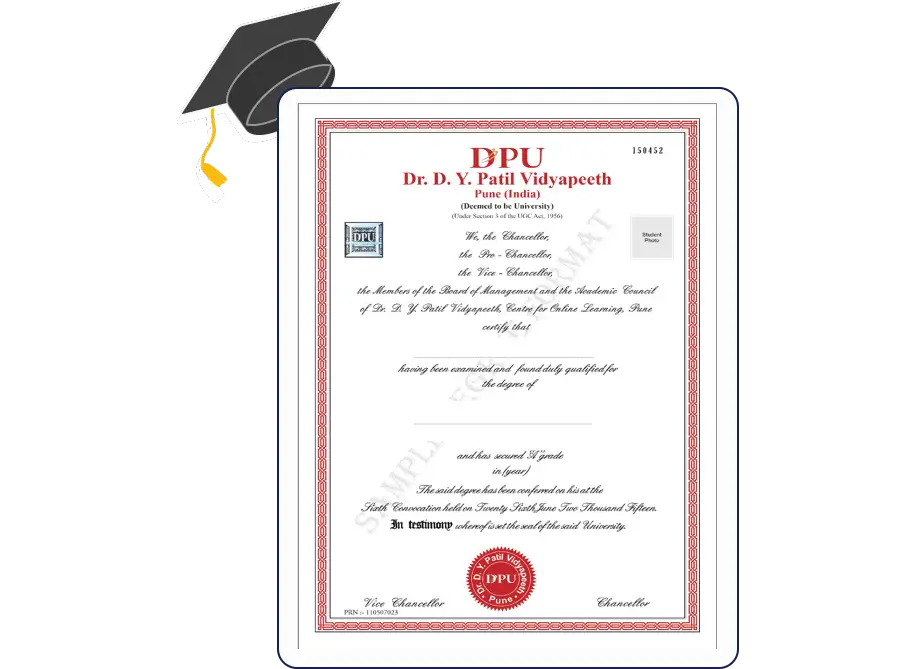
Who Can Apply ?
• Any graduate with minimum 50% marks from a UGC-recognised university is eligible for the DPU Online MBA in Project Management.
• Software project coordinators, construction site managers, or pharma R&D administrators with 1–5 years wanting to move into programme management leadership should apply now.
• Apply through the Online MBA project management course in DPU admission portal no CAT/MAT required, merit-based direct admission, and quick offer letter.
Course Syllabus
Semester 1
Principles of Management & Organisational Behaviour
Managerial Economics
Business Communication
Quantitative Methods for Project Management
Management Accounting
Research Methodology
Semester 2
Human Resource Management
Project Management Fundamentals
Operations & Supply Chain Management
Strategic Management & Business Policy
Management Information Systems
Entrepreneurship Development
Semester 3
Advanced Project Scheduling & Budgeting
Risk Management & Quality Control
Agile & Scrum Frameworks
Procurement & Contract Management
Project Simulation Lab I
Elective I (e.g., Digital PM Tools or Business English)
Semester 4
Quantitative Methods in Project Management
Project Quality Management
Generic Elective-II (Soft Skill/ Business Ethics and Corporate Governance)
Project Work Report
Job Roles
Connect with our expert counsellors to get personalized guidance tailored to your unique career journey. Whether you're exploring new opportunities or planning your next big step, our team is here to support you at every stage with clarity and confidence.
Get one-on-one guidance based on your academic background and experience
Discover programs aligned with your career goals and future aspirations
Receive insights on industry trends, job roles, and growth opportunities
| Job Roles | Average Salary | Key Skills | Age Group |
|---|---|---|---|
| Project Coordinator, Scrum Master Trainee, PMO Analyst | ₹8 LPA | PMBOK basics, Jira, Agile/Scrum, MS Project | 21 |
| Project Manager, Programme Manager, Agile Coach | ₹16 LPA | PMP advanced, EVM, Stakeholder management | 25 |
Top Recruiters
Students pursuing the DPU Online MBA in Product & Project Management can explore career opportunities with companies such as Microsoft, Apple, Google, and Amazon.





Explore Other Specializations from DPU

FAQs
Is this MBA recognised in project-driven industries?
Yes. This is a UGC-entitled and industry-aligned MBA that holds credibility across project-driven sectors such as IT services, construction, consulting, infrastructure, product development, and even creative industries like media and design. Employers recognize the degree because the curriculum combines both theoretical project frameworks and practical execution models. Graduates are considered ready for leadership roles in cross-functional project environments where deadlines, budgets, and stakeholder management are critical.
Do I need certification like PMP before joining?
No. Prior certifications such as PMP, PRINCE2, or Agile badges are not required. The program is designed to introduce these frameworks from scratch and build your expertise gradually. You will learn project lifecycle planning, risk analysis, quality standards, Agile methods, and PMI-aligned principles as part of the coursework. For students who wish to pursue formal certification later, the MBA builds the right foundation, making it easier to clear PMP or Agile certification exams after graduation.
Are simulation-based exercises and capstone projects included?
Yes. To bridge theory and practice, the program integrates simulation labs, case studies, and a final-semester capstone project. These simulations replicate real-world project scenarios—such as handling budget overruns, team conflicts, or Agile sprint delays—so you practice decision-making in a safe, guided environment. The capstone project often involves live business cases or industry collaborations, giving you exposure that strengthens both your skills and your resume. In addition, dedicated placement support is available to help leverage these projects for career opportunities.
What project roles are eligible after completion?
Graduates can step into diverse roles such as Project Manager, PMO (Project Management Office) Lead, Agile Coach/Master, Risk Manager, and Project Controls Analyst. Depending on your background, you could also move into Business Analyst, Program Manager, or Operations Head roles. Since project management is a transferable skill, career opportunities are not limited to one sector—you’ll find demand in IT, healthcare, construction, manufacturing, BFSI, and government projects alike.
Are Agile and Scrum methodologies part of the syllabus?
Yes. Agile project management is a key focus area of this MBA. In Semester 3, you will study Agile principles, Scrum frameworks, sprint planning, and iterative development models. These are not just taught in theory—labs and group exercises allow you to simulate Scrum ceremonies like daily stand-ups, sprint reviews, and retrospectives. By the end of the program, you’ll have practical confidence in using Agile methodologies, which are increasingly the standard in IT and service-based industries.
Can I choose electives?
Yes. The MBA provides the flexibility to customize your learning through two electives in Semesters 3 and 4. Electives are often categorized into technical tools (such as MS Project, Primavera, or JIRA) and professional skills (such as communication, negotiation, or business ethics). This ensures that you can shape your MBA to match your career goals—for instance, tech-focused students may lean into software tools, while leadership aspirants may select professional skills.
How many subjects are there in total?
The program covers approximately 25–27 subjects across four semesters. These include core management courses (finance, strategy, HR, marketing), specialized project management subjects (risk, quality, scheduling, contracts, governance), tool-based labs, and electives. The structure is well-balanced to ensure you develop both technical expertise and strategic leadership skills.
Can this be done alongside full-time work?
Absolutely. The MBA is designed for working professionals and career switchers. Classes are conducted online with live sessions (usually evenings/weekends) and recorded lectures available for flexible access. Assignments and exams are scheduled with working individuals in mind, and many students apply their learnings directly in their current workplace. This makes the program an excellent choice for those who want to upskill without taking a career break.
Are scholarships or EMI plans available?
Yes. Universities offering this MBA provide early-bird discounts, merit scholarships, and flexible EMI/loan facilities to ease financial pressure. Some institutions partner with banks and fintech providers to offer no-cost EMI schemes. Scholarships are often based on academic merit, early enrollment, or corporate sponsorships, making the program more affordable for a wider pool of learners.
What tech is required for project labs?
You’ll need a laptop/desktop with stable internet access to attend classes and run project simulations. Basic system requirements usually include at least 4GB RAM and updated browsers. Access to specialized project management software (such as JIRA, MS Project, or simulation tools) will be provided through the university, so you don’t need to purchase them separately. The Learning Management System (LMS) will serve as your central hub for coursework, assignments, labs, and collaboration with peers.