Can an Online BCom Help You Prepare for ACCA, CFA or CPA?
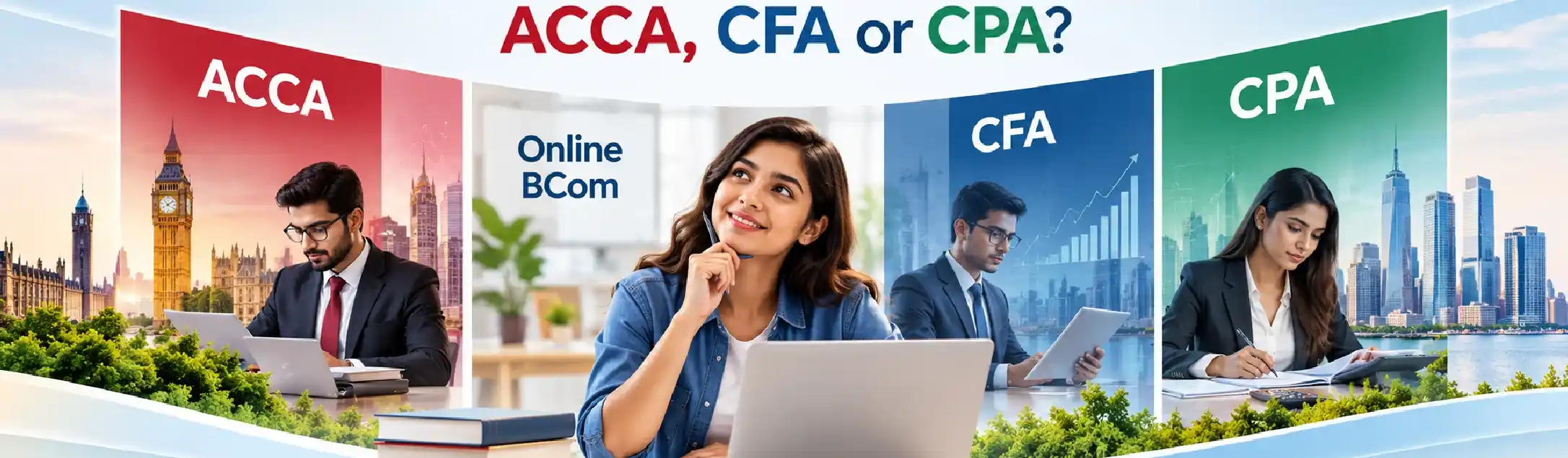
Yes, it can. A good Online BCom teaches accounting, tax, law and economics, and ACCA, CFA and CPA all lean on these subjects. It won't replace the exams. You'll still sit those on their own terms. What it gives you is a base, plus the time to build on it.
Maybe you've just finished Class 12 in Nashik and want to pick a first step. Or maybe you work in accounts in Gurugram and want to finish your degree without leaving your desk. This post is for both of you.
The same questions come up again and again. Which exam fits me? Which BCom subjects help? How do I fit it all in? This post answers each one and ends with a checklist you can use before you enrol.
What ACCA, CFA and CPA Actually Ask From You
These three names sound alike, but they lead to different careers.
ACCA
ACCA stands for the Association of Chartered Certified Accountants. It's a global accounting qualification, and you earn it by clearing a series of papers on financial reporting, audit, tax and management accounting. If your BCom had strong accounting and tax subjects, you'll feel at home in the early papers.
Some degrees even earn exemptions from certain ACCA papers. That depends on ACCA's agreement with your university, so check ACCA's official page for the current list before you pick a course.
CFA
CFA means Chartered Financial Analyst, and the CFA Institute runs it. The focus is investments, markets and portfolio work. There are three levels, and each one builds on the last. The economics and statistics you pick up in a BCom make Level I easier to follow.
People often take it for roles like research analyst or portfolio associate. Entry rules are set by the CFA Institute and can change. They usually depend on whether you have completed a bachelor's degree, are in the final year of one, or have enough work experience. Read the CFA Institute's official page before you register.
CPA
CPA stands for Certified Public Accountant. It's a licence from the United States, built around accounting, audit and tax. Each state board of accountancy sets its own education rules, so the state you choose matters.
Many boards use a credential evaluation service to review degrees from other countries, and some set credit-hour rules for accounting and business subjects. Write to your board, ask how it reads a BCom, and keep the reply on file. A BCom with accounting, audit and business law covers a lot of the groundwork.
Jobs and Cities Where These Paths Lead
Look at job posts in this space and you'll spot titles like Audit Associate, Tax Consultant, Financial Analyst, Equity Research Associate, Credit Analyst and Management Accountant. Firms in Mumbai, Bengaluru, Gurugram, Hyderabad, Chennai and Pune hire for them.
No degree or exam promises a job. Still, a degree plus a professional exam tells an interviewer that you finish what you start.
What an Online BCom Gives You for Exam Preparation
Subjects That Carry Over
Most BCom programmes cover financial accounting, cost accounting, auditing, taxation, business law, economics and statistics. Syllabi differ by university, so open the one you like and read it line by line.
The match is simple. Accounting and audit feed ACCA and CPA. Economics and statistics feed CFA. Business law helps all three, because every finance job runs on rules.
Local Rules, Global Standards
Many BCom programmes teach GST, income tax and the Companies Act. That knowledge helps you in Indian finance roles from day one. ACCA and CPA then add international standards on top, and you end up comfortable with both worlds.
A degree also gives you something a self-study plan often lacks: deadlines, mentors and classmates. When exam season gets busy, that rhythm helps.
Skills Employers Notice
Exams are only half the picture. Recruiters like to see practical skills, such as reading financial statements and building a simple model in Excel. Many students add Tally or Power BI too, and it shows. If you enjoy tech, a BCom in Computer Applications adds digital skills to your accounting base.
Why Studying Online Works
Many online degrees offer live classes and recorded lectures. So you can study a degree paper on a weeknight and an exam paper on Saturday morning. Check the course page for class timings and exam dates before you commit.
ACCA, CFA or CPA: Which One Fits You?
Think about the work you'd enjoy on an ordinary Tuesday.
If you like standards, ledgers and audit trails, ACCA is a natural pick. Your accounting and tax subjects do most of the heavy lifting. If markets and company research excite you, look at CFA, where economics and finance are the stars. And if you want a US licence, CPA is the one, as long as your state board accepts your degree. Check that first.
Not sure yet? That's fine. Many students read the first paper or two from different paths before choosing. A week of reading can save months of doubt.
Choosing the Right BCom Specialisation
Pick a specialisation that points toward your target exam. Specialisation names differ from one programme to another, so check the exact names on the course page. These are the kinds of options to look for:
Accounting and finance suits ACCA and CPA very well.
Corporate accounting goes deep into company accounts.
International finance and accounting is a good match for global exams.
Business economics gives CFA candidates a strong economics base.
Thinking about studying further later? An Online MCom in accounting and finance is one road. An Online MBA in finance is another.
Four Students, Four Plans
These are made-up examples, not real students. They show how the idea can work in daily life.
Meera finishes Class 12 commerce and joins an online BCom in accounting and finance. By second year she's reading her first ACCA papers on weekends. Her goal is an audit team in Pune.
Arjun is an accounts executive in the final year of his online BCom. Weeknights go to degree lectures. After checking the CFA Institute's entry rules for final-year students, he plans to start CFA Level I and give Saturday mornings to it. He's aiming at equity research.
Fatima wants the CPA. Before anything else, she reads her chosen state board's rules and emails them to ask how they treat her degree. Only then does she pick a BCom heavy on accounting and business law.
Rohan loves both numbers and tech. He joins a BCom in Computer Applications, learns Power BI on the side, and plans an MBA in finance later.
What matters is a clear goal and a routine you can keep.
A Simple Plan to Combine Your Degree and Exam Prep
Ready to start? Take these steps in order.
Pick one target exam and read its official page.
Choose a BCom specialisation that matches it.
Confirm the university is UGC-recognised and NAAC-accredited.
Lay your degree syllabus beside the exam papers and mark the overlaps.
Study one exam paper at a time, alongside your semester work.
Build a small Excel project, like a ratio study of a listed company.
Book time with a career counsellor whenever you want a second opinion.
Map Your Syllabus to Exam Papers
Grab a sheet of paper and draw two columns. Degree subjects go on the left, exam papers on the right. Now draw a line wherever the topics match.
Each line is an hour of study that helps twice. Your degree's taxation paper, for instance, supports the tax paper in ACCA. Degree study doesn't count towards the exam itself, but once you see the overlaps on paper, the whole plan feels lighter.
A Sample Week
Here's one way a working student might shape a week. Monday and Wednesday evenings go to degree lectures. Tuesday and Thursday get an hour of exam reading each. Saturday holds three hours of practice questions, and Sunday is for rest.
Change it to fit your life. Even five hours a week adds up over a year.
What to Check Before You Enrol
A short checklist helps you choose with confidence.
UGC recognition. UGC is the University Grants Commission. Check that the university is recognised by UGC and approved to offer the online programme.
NAAC accreditation. NAAC is the National Assessment and Accreditation Council. Check that the university is NAAC-accredited and note the exact accreditation level it holds.
Approvals. Look for the programme's approval details on the university's official page. AICTE, the All India Council for Technical Education, looks after technical programmes, while a BCom sits under UGC.
Syllabus. Look for accounting, audit, tax and economics.
Class timing. Make sure live classes suit your job and your exam dates.
Exam body rules. Ask ACCA, the CFA Institute or your state board how they read the degree.
Career help. Look for support like resume building once you're closer to applying.
Not sure which programme fits your goal? Try CourseConnect's course matching to shortlist options that suit your target exam and your schedule.
Questions to Ask a Counsellor
Which papers in this BCom match my target exam?
Do live classes run in the evening or at weekends?
Are lectures recorded, so I can catch up later?
Has any student here combined this degree with ACCA, CFA or CPA?
Where can I see the university's UGC recognition and NAAC accreditation details?
Conclusion
An online BCom works best for exam preparation when you plan the degree and the exam together. The degree builds your base. The exam adds a specialist skill. And the online format lets you do both at your own pace, with progress you can see every semester.
Ready to compare options? Explore the programmes on CourseConnect. This week, take one small step: read one official exam page and one course page.
FAQs
Can I do ACCA, CFA or CPA after an online BCom?
Yes. Each body sets its own entry rules, so read the official page first. CFA entry usually depends on a completed degree, final-year status or work experience, and CPA rules depend on your state board.
Does an online BCom give ACCA exemptions?
It can, but it depends on ACCA's agreement with your university and degree. Check ACCA's official list before you enrol, so you know exactly what you'll get.
Which BCom subjects help most for CFA?
Economics, statistics and finance help most. Look for them in the syllabus of any programme you're considering, because they make the early levels easier to follow.
Can a working professional study an online BCom and prepare for CPA?
Yes. Many online programmes offer recorded lectures, so you can study around work. Plan one exam section at a time, and check your state board's rules first.
Is an online BCom valid for these exams?
A degree from a UGC-recognised university is valid under UGC rules. Each exam body then decides how it reads your degree, so confirm with them before you start.
Talk to our Career Companion

Sukanna Kundu
An MBA in Digital Marketing professional and an experienced content writer who loves mixing creativity with SEO strategy to create content that actually connects with users. From writing SEO-friendly blogs and decoding k...
Read more