Online Degree Verification Process: What Employers and HR Teams Check

Introduction
Online degrees have become quite popular among students and professionals nowadays. They are accepted by employers, and many organisations recruit online degree holders. Before hiring you, the HR department of the company verifies your academic credentials.
The process of verification is also simple, as it only requires the HR team to check the UGC status of the university and the UGC-DEB recognised status of the program, followed by matching the candidate's records with the university records. In this article, we will explain the process of verification and what aspects are checked by the HR team.
Process Followed in Online Degree Verification
Most companies don't verify degrees themselves. They hire a background check agency, and AuthBridge and First Advantage are names you'll bump into often. A few bigger firms keep it in-house with their own HR people, which works fine too.
Here's roughly how it goes:
You hand over your degree certificate, mark sheets, and enrolment number
You sign a consent form
The agency writes to your university or uses its online portal
The university confirms your records
The employer receives the report, and your file moves on
Things got a lot quicker once records went digital. Plenty of Indian degrees now live on the National Academic Depository (NAD) and DigiLocker, so HR can pull them up in minutes. When the agency has to write to the university, a reply tends to arrive within one to three weeks. Some come back in two days.
One student I advised, a BCom graduate in Kolkata, kept everything in a single folder. Her certificate, all six semester mark sheets, even a scan of her ID. Her check cleared in an afternoon. Her new manager mentioned it in the first week, and I still think of her whenever someone asks how to prepare.
What HR Teams Check During Online Degree Verification
HR wants one clear answer. Is this degree valid, and does it match what you told them? A short checklist gets them there, and it's friendlier than it sounds.
They usually look at:
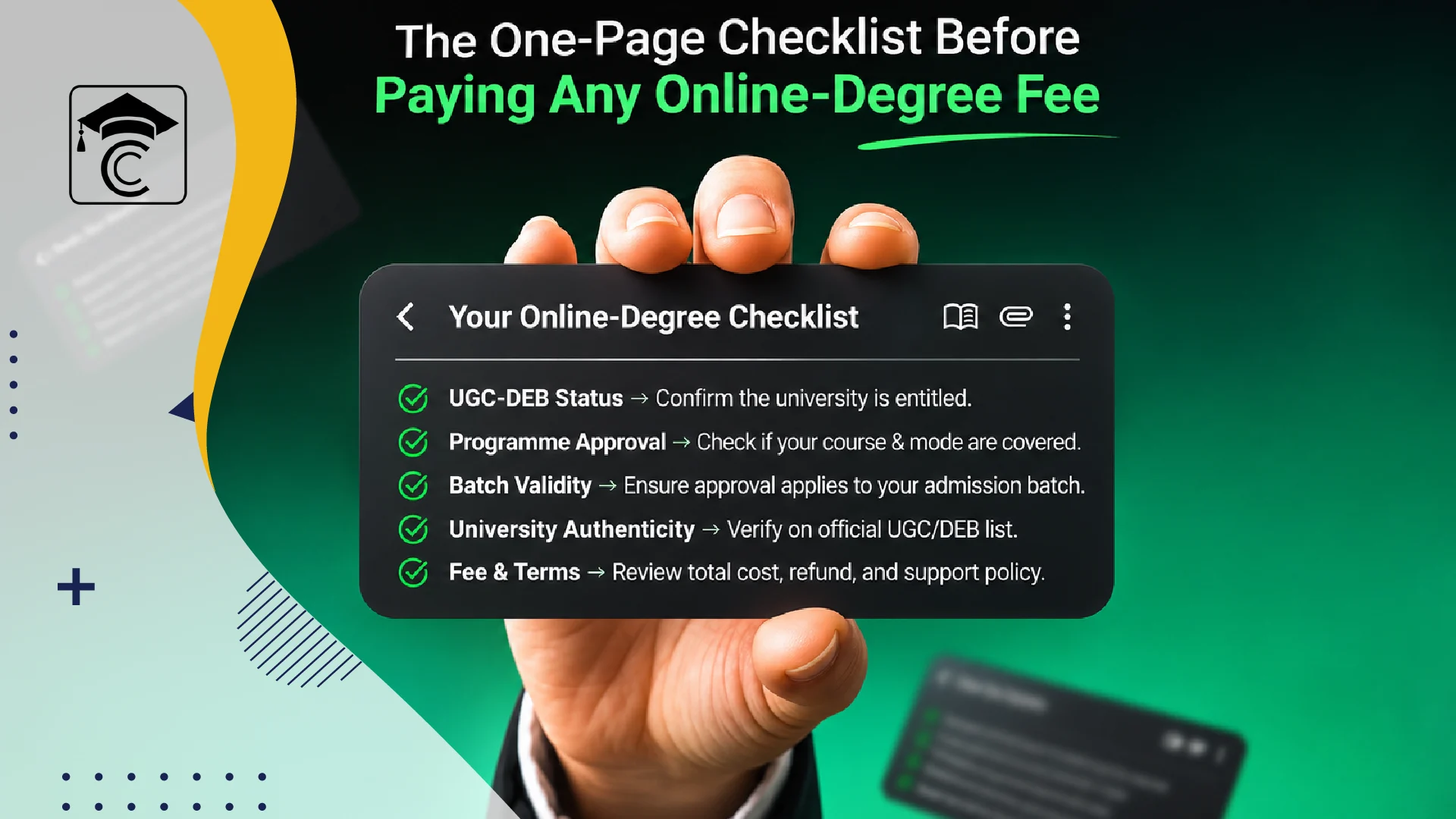
University recognised by the UGC: This is the first stop. HR confirms the university holds UGC recognition, so your degree sits on solid ground.
University listed on the UGC-DEB portal: For online degrees, HR opens the official website of UGC-DEB and finds your university on the entitled list. It takes a minute.
Your exact program under that university: Entitlement works program by program. HR looks for your course, say online MBA or BCom, next to the university’s name.
The session you enrolled in: The list updates every session. HR checks that your university was accredited in the year you joined.
NAAC accreditation, which many teams like to see: A good NAAC grade adds extra comfort. It tells HR the university keeps healthy academic standards.
Regarding the AICTE approval of your degree. Numerous management and technical courses have received AICTE approval. If your course is one of these approved courses, it will be appreciated by HR.
The name, date of birth, and enrollment number in the CV need to display uniformity with the ID document. The name must be the same in all documents.
Program name and specialisation: HR compares what’s on your certificate with your resume. Writing “MBA in Marketing” exactly as printed keeps things neat.
Mode of study (regular, distance or online): Many reports record the mode. Online degrees from accredited universities carry the same value as regular ones.
Program duration: The time you took should fit the program length. A two-year MBA completed in two years reads perfectly.
Year of admission and year of passing: Both years should match your resume and the university’s records. Copy them straight from your certificate.
Marks or CGPA, mostly for fresher roles: Some employers want your scores, especially for first jobs. Keep your mark sheets handy and you’re covered.
Seal, signature, serial number and QR code on the certificate: These show your certificate is genuine. HR matches them with university records, and a clear scan helps.
The UGC-DEB part deserves a minute, because it's the piece that's specific to online degrees. DEB is the UGC's Distance Education Bureau. It publishes the list of universities entitled to run online programs, program by program, and refreshes it every session. You can find it at the official website of DEB. HR searches for your program and your year, and it takes them seconds.
A degree from a UGC-DEB-entitled university stands equal to a regular degree from the same university. Employers know this, and they respect it. In my experience, recruiters rarely ask whether a degree was online. They ask whether they can verify it. Clean report, happy recruiter. Simple as that.
Some candidates even attach their university's verification link to the application. It saves them a step and shows you're proud of your degree. If you're eyeing a job abroad, a credential evaluation by a service like WES may come next. It usually follows once your Indian university confirms the degree. With tidy records, it goes smoothly.
The Importance of Accurate Academic Details in Job Applications
Clear details make joining day easy. HR closes your file sooner, and your new manager trusts you from the start.
Small slips happen to the best of us. You type the passing year from memory. You shorten the university name. You write "completed" while the last result is still on its way. HR sees this daily and simply asks you to confirm. A quick, honest reply sorts it out in a day or two.
Honest details pay off in a few ways:
Your file clears faster
Your recruiter feels sure about you
Future background checks run smoothly
Your resume, LinkedIn and certificates tell the same story
I remember a candidate who listed his MBA as complete while one paper was still pending. His offer waited three weeks for the final result. He joined happily afterwards. Now he copies every date straight off his certificate, and his next application cleared in two days. A tiny habit with a big payoff.
A few habits that help any candidate:
Copy details from your certificate
Keep soft copies of your degree, mark sheets and enrolment number
Check your university on the UGC-DEB portal before you enrol
Tell HR early if a result is on its way
Write your name the same way everywhere
Match the dates on your resume and LinkedIn
Verification works in your favour too. A quick look at your university's status before admission gives you real peace of mind. You begin your program knowing employers will recognise it, and that confidence stays with you through every semester.
Conclusion
Degree verification isn't complicated, but rather an essential step. HR checks the university’s UGC status, UGC-DEB accreditation, program details, and certificates. Clear information in your resume would take care of the rest.
When opting for an online degree, it is crucial to search for a UGC-DEB-accredited university offering the course of your choice. You can also get a roadmap for verified programs on the CourseConnect page.
FAQs
What does HR check in background verification?
HR usually looks at ID proof, address, your last one or two jobs, and your education. A few roles, like banking, add police clearance too. The depth changes from company to company. Your degree tends to be completed early, mostly when it's on NAD or DigiLocker.
What documents do I need for degree verification?
There are usually three documents that have to be provided for degree verification, which include the certificate of the qualification attained, the transcript containing the marks for all the semesters, and the enrollment number for the concerned course.
How long does HR take to verify an online degree?
Depends on where your records sit. A degree on NAD or DigiLocker can be confirmed in a few minutes, or a day at the very most. If the agency has to write to your university, plan for one to three weeks. Many universities answer in under a week, so you may well be pleasantly surprised.
Do employers verify online degrees differently from regular degrees?
No. The agency still checks your certificate, marks, and identity like it does for anyone. There's just one extra tick for online graduates: HR confirms your university is UGC-DEB entitled for your program. After that, your degree stands level with a regular degree from the same university.
What does the employer check for Online Degree Verification?
Mainly four things. First, that your university is UGC recognised and UGC-DEB entitled. Second, your exact program. Third, your name, enrolment details, and passing year. Fourth, that your certificate is genuine. When the details match, each check moves fast.
Talk to our Career Companion

Sukanna Kundu
An MBA in Digital Marketing professional and an experienced content writer who loves mixing creativity with SEO strategy to create content that actually connects with users. From writing SEO-friendly blogs and decoding k...
Read more