





Mysore Online MBA in Financial

Course Overview
University of Mysore offers an Online MBA in Financial Management. It runs for 2 years. CDOE delivers this UGC-recognised degree. Corporate finance leadership builds here.
The course covers corporate finance. Investment analysis gets included too. Treasury management follows. Tax planning and financial reporting round it out.
Students build equity valuation skills. Ratio analysis grows too. Financial forecasting gets practised. Data-driven decision-making skills build fast.
Graduates step into bank finance roles. NBFC jobs open too. Consulting firms and corporate treasury teams stay open across India's financial sector.
Accreditations
UGC-Recognised | NAAC A+ Accredited University of Mysore | AIU Member Institution. The online mba in financial management carries full degree validity — accepted for government promotions, bank jobs, and senior finance roles in India's top organisations.

NAAC A

NIRF

DEB

AICTE
Course Highlights
Designed to deliver industry-relevant skills, academic excellence, and career growth
- University of Mysore is UGC-recognised. NAAC A+ institutional backing applies here. India's top BFSI employers accept this degree. Consulting firms accept it too.
- This MBA holds degree equivalence with a campus MBA. Government job applications accept it. PSU promotions accept it too. Senior finance leadership positions stay open.
- Check the syllabus at the CDOE portal. Corporate finance gets covered semester-wise. Derivatives and investment banking follow too. Tax planning rounds it out.
- The programme uses real financial case studies. Excel-based modelling labs follow too. Live sessions on market analysis prepare you for finance roles from day one.
- Any graduate with 50% marks can apply directly. No entrance test gets required. Eligibility stays accessible to all qualified graduates.
- Begin the admission process at the CDOE portal. It stays fully digital. Merit-based decisions take minutes to complete.
Course Benefits

Earn a UGC-recognised MBA in Finance from NAAC A+ accredited University of Mysore. Banks and NBFCs trust this degree. India's top finance employers trust it too.

Master financial modelling skills. Investment analysis gets included too. Tax planning follows. Applied projects align with live sessions and industry practice.

Access University of Mysore's career guidance network. HDFC connections apply here. Deloitte follows too. Leading finance employers stay accessible.

Graduate with CFO-ready skills. Capital allocation gets included too. Strategic planning and corporate valuation command higher salaries across financial services.
Course Fees
The fee structure for this Mysore Online MBA in Financial is designed to be affordable and flexible for both freshers and working professionals


Total 4 semester
INR 22,500 / Semester
*Fees may vary kindly check the actual fee with our counsellor
Full course fee
INR 90,000
*Inclusive of all taxes
EMI starting at
INR 3,750 / Month
*Terms & Conditions apply
Eligibility
- »
Any graduate or postgraduate in Arts, Science, Commerce, Business Management, Allied Sciences, Engineering & Technology, or Medical Sciences of this University or from any other university considered equivalent thereto shall be eligible for admission to the course.
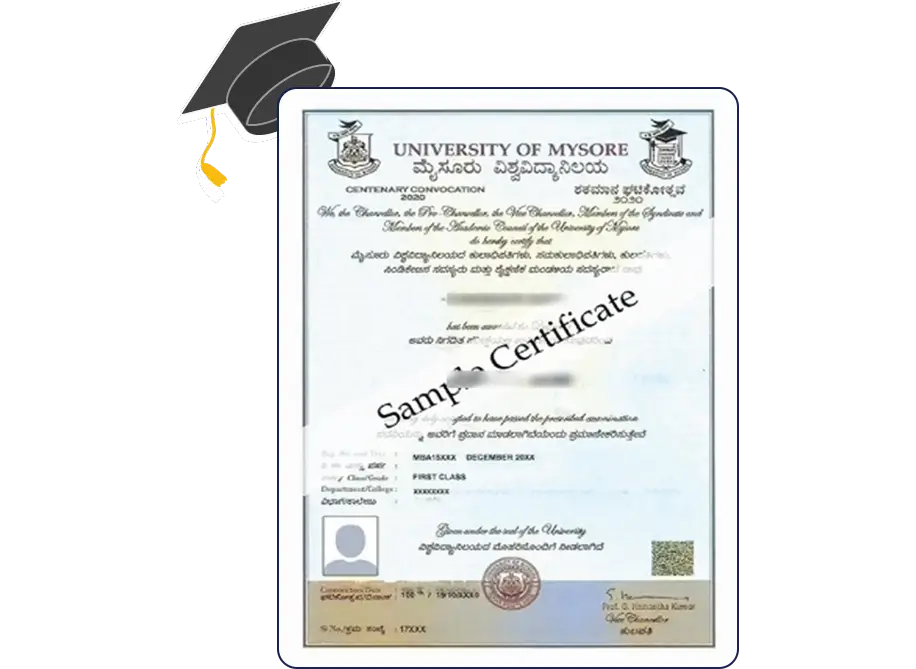
Who Can Apply ?
• Any graduate with 50% marks from a recognised university — in commerce, science, or any other stream — can apply directly without any entrance exam.
• Working accountants, banking executives, and finance analysts seeking to advance into senior finance management roles will gain the most from this program.
• Apply at the University of Mysore CDOE portal — merit-based, open enrollment, and quick online application process.
Course Syllabus
Semester 1
Management Concepts & Theories
Organizational Behaviour
Business Environment
Managerial Communication
Managerial Accounting
Managerial Economics
Statistics for Management
Semester 2
Marketing Management
Human Resource Management
Corporate Finance
Quantitative Methods
Legal aspects of Business
Operations Management
Management Information Systems
Semester 3
Entrepreneurship
Elective - I - Financial Derivatives
Elective - II - International Financial Management
Project Management
Project Work Diary
Summer Internship Report
Elective - III - Risk Management
Semester 4
Elective - IV - Financial Engineering
Elective - V - Portfolio Management
Project Report
Elective - VI - Security Analysis and Investment
Strategic Management
Project Viva-voice
Elective - VII - Corporate Taxation
Job Roles
Connect with our expert counsellors to get personalized guidance tailored to your unique career journey. Whether you're exploring new opportunities or planning your next big step, our team is here to support you at every stage with clarity and confidence.
Get one-on-one guidance based on your academic background and experience
Discover programs aligned with your career goals and future aspirations
Receive insights on industry trends, job roles, and growth opportunities
| Job Roles | Average Salary | Key Skills | Age Group |
|---|---|---|---|
| Financial Analyst, Credit Analyst, Treasury Executive | ₹4 LPA | Financial Modelling, Excel, Financial Reporting | 22 |
| Finance Manager, Investment Analyst, Risk Manager | ₹8 LPA | DCF Valuation, Portfolio Management, Risk Analysis | 25 |
Top Recruiters
Students pursuing the University of Mysore Online MBA in Finance & Accounts can explore career opportunities with companies such as Aditya Birla Capital, Bajaj Capital, Bajaj Finance, and Bajaj Finserv.







Explore Other Specializations from University of Mysore




FAQs
Is University of Mysore Online MBA in Finance UGC approved and recognized?
Yes, University of Mysore's Online MBA in Finance is UGC-approved and recognized across India, holding the same academic value as regular MBA degree for jobs and higher education.
What is the eligibility for MBA Finance online at University of Mysore?
Candidates need a bachelor's degree in any discipline from a recognized university with minimum required percentage to apply for University of Mysore Online MBA in Finance.
What is the Online MBA in Finance fees at University of Mysore?
University of Mysore offers competitive fees with flexible payment options for Online MBA Finance program. Contact CourseConnect for detailed fee structure, payment plans, and admission guidance.
How to apply for University of Mysore Online MBA Finance admission 2026?
Apply through CourseConnect for seamless admission support. Our counselors assist with application, eligibility verification, document upload, fee payment, and complete University of Mysore Online MBA Finance enrollment.
What career opportunities exist after completing Online MBA in Finance from University of Mysore?
Graduates can work as Financial Analysts, Investment Bankers, Finance Managers, Portfolio Managers, Risk Analysts, Financial Consultants in private sector, government jobs, banks, MNCs, and financial institutions.