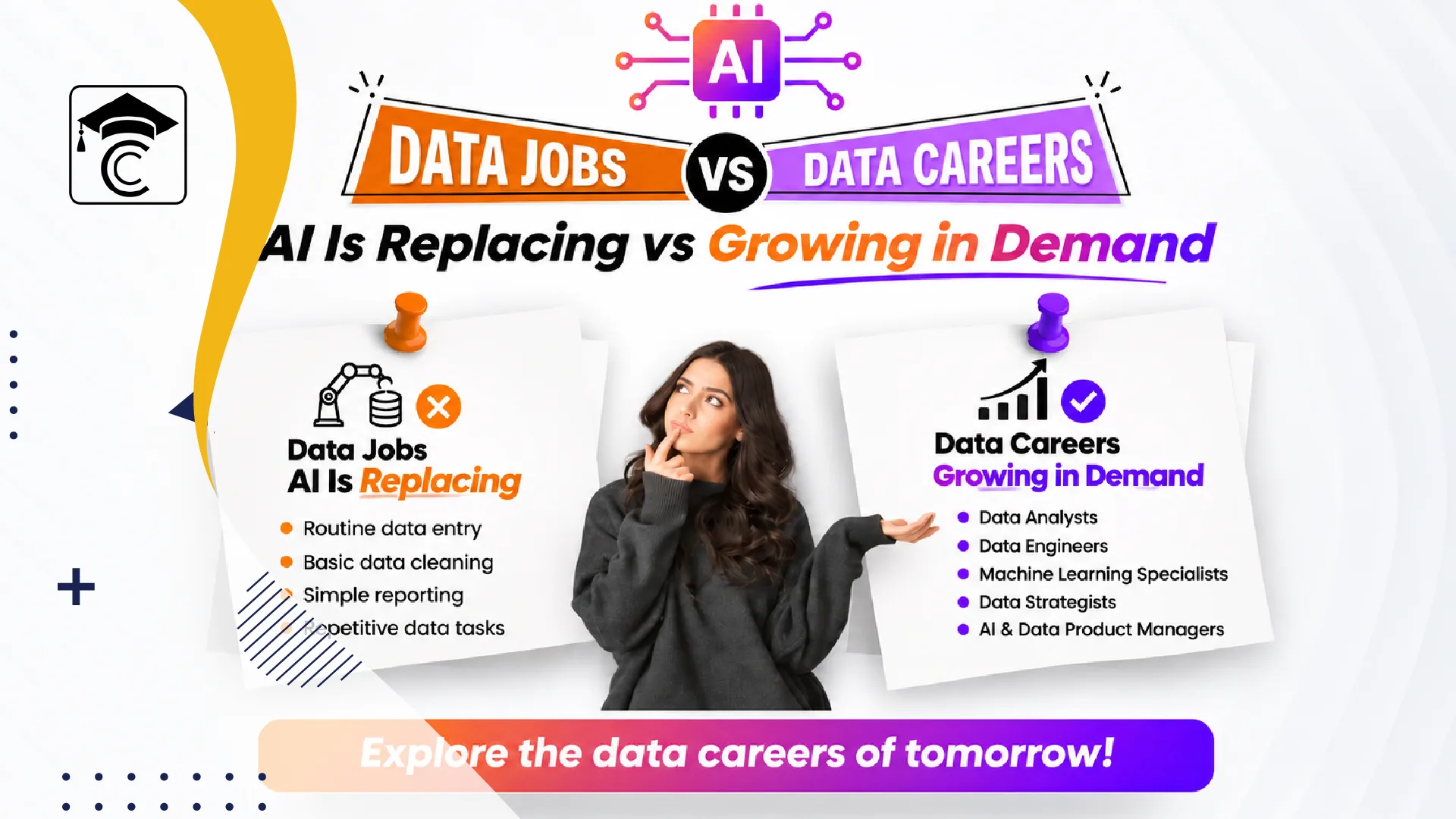
AI is cutting AI-Enabled workers too: why AI skills alone are not a safe harbour

AI-enabled workers already hold the skill that Gallup, Naukri, and Indeed say employers value most” is now “Gallup, Naukri and Indeed all show that employers value AI skills.
Key Takeaways
AI use is a real advantage. Gallup found that US tech workers who use AI at least monthly enjoy stronger job security, with a 6% predicted layoff probability against 18% for lighter users.
Pay follows proof. Indeed India found that 66% of employers offer premiums for AI skills, so a measured result is your best path to a raise.
Your next step is owning outcomes. UGC-DEB entitled online education from Indian universities can build the finance, project, and strategy skills that this step needs.
Who Are AI-Enabled Workers?
Maybe you are one already. AI-enabled workers use tools like ChatGPT, Gemini, and Microsoft Copilot to do a normal job better, and they thrive in marketing, finance, HR, design, sales, support, and operations. They also love the smart features inside Excel, Canva, and Salesforce. Builders at companies like Google create the models, while AI-enabled workers apply those models in their own fields.
This group is growing fast. Naukri's World AI Day Report 2026 found AI skills in 15.4% of tech job descriptions, up from 0.9% in 2020. Naukri also found AI skills in non-tech roles climbing from 0.26% to 1.59%. PwC's 2026 barometer adds that human skills such as judgement, creativity, and leadership are gaining weight.
How the AI-Enabled Workflow Goes
Most AI-enabled work follows five simple steps that any ChatGPT or Microsoft Copilot user can master. We call this original model Frame–Prompt–Draft–Check–Deliver.
Frame. You choose a clear goal and define what success looks like for your manager.
Prompt. You give ChatGPT or Copilot sharp instructions and the right business context.
Draft. The AI tool writes a strong first version in seconds.
Check. You review the draft for accuracy, fairness, and a great fit with the business goal.
Deliver. You shape the final output and proudly stand behind it in front of your team.
AI shines at step three. That frees you to invest more time in steps one, four, and five, where judgement and communication create the most value for any employer, from TCS to Deloitte India.
Where Change Comes First, and Your Best Next Skill
SignalFire tracks 12 large US Tech Majors, including Alphabet, Meta, Apple, Amazon, Microsoft, and Block. Engineering hiring holds up best there, at 11% below 2019 while total hiring sits 25% below. Design, product management, and marketing sit 48%, 39%, and 36% below, which shows exactly where a fresh skill pays off fastest. These numbers cover big US firms, so treat them as a friendly planning signal for your own growth plan.
Every role has a clear next skill. Software engineers at Microsoft or Google grow fastest with system design and code review. Designers at Adobe and Canva gain strength through brand strategy and user research, while product managers build value with business cases and pricing. Marketers and content writers at HubSpot or Zoho win with audience insight and original reporting. SignalFire does not track support, HR, finance, and analyst roles, but service design, people analytics, and decision support offer excellent next steps.
AI-Enabled Roles Are Being Reshaped Too: Real Cases
Block, Atlassian, and Meta show how teams that already love AI are rebuilding around people who own results. In February 2026, Block rebuilt around a team of just under 6,000, down from over 10,000, and its leaders said a significantly smaller team using AI tools can do more and do it better. In March 2026, Atlassian restructured about 1,600 jobs, roughly 10%, and its leaders said AI does not replace people but does change the skills and roles needed. In May 2026, Meta restructured nearly 8,000 roles and moved about 7,000 others into AI teams.
Using AI was already the entry ticket at all three companies. They rebuilt around smaller teams that own results, and that pattern hands you a clear way to stand out.
India: Work Is Shifting, and Opportunity Follows
The growth story comes first in India. Naukri JobSpeak found AI hiring up 16% year over year in June 2026, outpacing overall IT hiring, which moved 3% lower. India's tech workforce also grew 2.3% to 59.5 lakh in FY26, which shows steady demand for skilled people.
Large IT firms are building around AI-led delivery too. TCS announced about 12,000 role changes in July 2025, mainly at middle and senior levels, and its CEO pointed to skill fit and deployment. Nomura's India economist says entry-level routine jobs are shifting while mid-level jobs are transforming. TCS still plans about 25,000 fresher hires in FY27, so doors stay open for new talent. Now TCS has made 25,000 fresher offers for FY27, down from 44,000 hired in FY26.
The pattern is encouraging for Indian professionals. Routine and mid-level work changes first, while AI-linked roles that own outcomes stay in demand.
Is AI the Real Reason? A Balanced View
Two credible views explain recent restructuring, and both help you plan. Challenger, Gray & Christmas reports that AI led all stated reasons for US job cuts for four months in a row. Through June, Challenger counted AI in 23% of announced cuts, and in 31% in June alone.
Gallup's worker survey adds a fresh angle. Only 1% of laid-off workers named AI or automation as the primary cause, and most pointed to restructuring, cost goals, and economic conditions. Gallup notes that the 1% likely understates AI's indirect role.
Both views agree on the best news for you: AI changes the mix of skills that companies need, and you can build those skills. Gallup also found that 62% of laid-off workers rarely or never used AI, against 50% of employed workers. Researchers add that AI use may simply mark an essential employee, so pair your AI habit with results you can show.
AI Skills Pay Well, and Business Skills Make That Pay Last
1 Finance compares AI-related tech roles with traditional IT roles in India, and the premium grows with experience. At 0 to 3 years, AI-related roles earn ₹6 lakh against ₹5 lakh, a 20% premium. At 3 to 5 years, the figures are ₹12 lakh against ₹9 lakh, a 33% premium. At 5 to 10 years, AI-related roles earn ₹22 lakh against ₹17 lakh, a 29% premium. At 10 years and above, they earn ₹36 lakh against ₹26 lakh, a 38% premium.
Global capability centres pay 30% to 50% more for AI and data specialists. Demand for AI talent grows about 25% a year, against supply growth near 15%. These figures cover AI-related tech roles, so they do not describe every AI-enabled job.
Indeed's AI at Work Tracker 2026 surveyed 1,267 employers and 2,541 employees across India. It found that 66% of employers offer significant premiums for AI-skilled roles, while 54% of AI-exposed workers say their pay is still catching up” is now “54% say their pay stayed flat or fell over the past year.
That gap is your opportunity. Indeed India's managing director says employers increasingly reward demonstrable skills over pedigree. A measured result gives you a strong case for a raise or a better role.
Check Your Career Strength: A Six-Question Self-Check
Give yourself one point for each yes answer.
Do I own a result that I can show in numbers?
Do I make decisions, not only drafts?
Have I improved my AI workflow in the last six months?
Can my team name a decision I made last quarter?
Do I know my company's money goals and how my work supports them?
Have I learned a skill this year that goes beyond tools?
A score of 5 to 6 shows a strong position, so keep building proof. A score of 3 to 4 shows a solid base, so start the 60-day plan below. A score of 0 to 2 marks a great time to begin, and the ladder below shows your next step. Treat this as a friendly thinking tool and not a prediction.
The Ladder of AI-Enabled Work
The Ladder of AI-Enabled Work is an original CourseConnect.in model with four steps, and each step builds more lasting value.
Step 1, Tool User. You use ChatGPT or Copilot to finish tasks faster, learn prompting and output checking, and build a before-and-after time saving.
Step 2, Workflow Builder. You redesign a whole process in Excel or Power BI, learn process design and data literacy, and build a process map with results.
Step 3, Outcome Owner. You own money saved, revenue gained, or errors cut, learn finance basics, project management, and analytics, and build a one-page business case with numbers.
Step 4, Decision Maker. You choose where AI fits and lead people, learn strategy, negotiation, and AI governance, and build a decision memo on why you chose an AI tool.
This ladder is also a practical way to upskill and reskill for an AI-proof career. Each step adds judgement, which is the part tools do not replace.
How Online Education Helps at Each Step
Online education lets you keep your salary, study in the evening, and test fresh ideas at work the next day. The right program depends on your step.
For the move from Step 1 to Step 2, a short certificate in AI, process design, or analytics from Coursera, NPTEL, or a university fits well. These programs usually run from weeks to a few months, and cost varies widely, so compare the total fee. Look for a trusted issuer and real project work.
For the move from Step 2 to Step 3, a certificate or PG diploma in analytics, project management, or finance builds the business skills you need. Length and cost vary by provider, so verify the syllabus and employer recognition.
For the move from Step 3 to Step 4, an online MBA suits an AI career focused on strategy, and an online MCA suits a technical path. Both run two years at minimum, and the university may allow up to four years. Online PG degrees in India range from ₹18,000 to ₹5,00,000, so verify UGC-DEB entitlement for the exact program.
Plan for two years if you want to finish on time, since four years is the most the university allows. Ready to compare? Look at UGC-entitled online MBA and MCA programs side by side on CourseConnect.in, and check each program page for the current total fee.
Conclusion
AI skills give you a strong starting line, and outcome skills give you a safe harbour. Climb the ladder one step at a time, build one proof point in 60 days, and choose UGC-DEB entitled online education when you are ready for the next step. Compare UGC-entitled online MBA and MCA programs on CourseConnect.in to find your perfect fit.
Faqs
Is AI cutting AI-enabled workers too?
AI is cutting jobs at companies that already use AI heavily. Block cut over 4,000 jobs, about 40% of staff, in February 2026. Atlassian cut about 1,600 jobs in March 2026. Meta laid off about 8,000 people in May 2026. Meta also moved about 7,000 others into AI teams. Atlassian said AI changes the skills and roles needed.
Why are AI skills alone not a safe harbour?
AI skills alone are not a safe harbour because they are now common. Naukri found AI skills in 15.4% of tech job descriptions in 2026. That share was 0.9% in 2020. Indeed India says employers reward demonstrable skills over pedigree. Build proof with numbers, such as a one-page business case.
Do AI skills still protect your job?
AI use gives US tech workers stronger job security, according to Gallup. Gallup found workers who use AI monthly face a 6% predicted layoff probability. Lighter AI users face an 18% probability. Researchers say AI use may simply mark an essential employee. Pair AI skills with results you can measure.
Is AI the main reason for job cuts?
Challenger, Gray & Christmas and Gallup give different answers on AI job cuts. Challenger counted AI in 23% of announced US job cuts through June 2026. Gallup found only 1% of laid-off workers named AI as the primary cause. Most workers pointed to restructuring, cost goals, and economic conditions. Both sources agree that AI changes the skills companies need.
Which AI-enabled roles face the most pressure?
SignalFire tracks hiring at 12 large US Tech Majors, including Alphabet, Meta, and Microsoft. Design hiring is 48% below 2019. Product management hiring is 39% below, and marketing is 36% below. Engineering hiring is 11% below, the smallest drop. These numbers cover big US firms only, so use them as a planning signal.
How much do AI-related jobs pay in India?
1 Finance found that AI-related tech roles in India pay more than traditional IT roles. The premium is 20% at 0 to 3 years, with ₹6 lakh against ₹5 lakh. At 10 years or more, it is 38%, with ₹36 lakh against ₹26 lakh. Indeed India found 66% of employers offer premiums for AI skills. It also found 54% of AI-exposed workers say pay stayed flat or fell.
What skill should AI-enabled workers learn next?
The best next skill for AI-enabled workers is owning business outcomes. CourseConnect.in’s Ladder of AI-Enabled Work has four steps: Tool User, Workflow Builder, Outcome Owner, and Decision Maker. Outcome Owners learn finance basics, project management, and analytics. An online MBA builds finance and strategy skills. An online MCA suits a deep technical path. Both run two years at minimum.
How do you check that an online degree is valid in India?
The UGC-DEB portal at deb.ugc.ac.in confirms whether an online degree is valid. For 2026-27, UGC entitled about 120 institutions to award full online degrees. Approval for an online MBA does not cover an online MA. Check the exact program and session before you enrol. See how employers verify online degrees.
Talk to our Career Companion


Subham Sekhar
A market research and content strategy professional specializing in audience psychology, digital advertising, strategic planning, and content creation to help brands connect with their target audiences and achieve their ...
Read more