
SWAYAM: A Guide to India’s Government Online Learning Platform
Introduction
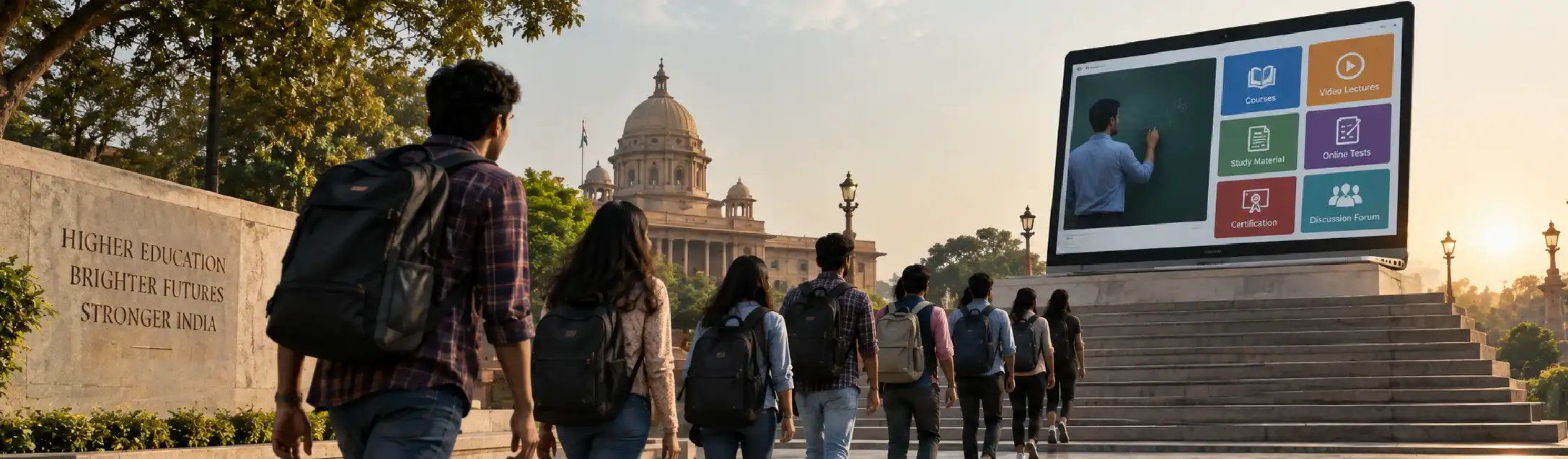
Top colleges are concentrated in a few cities in India. Students in other places have fewer options. That's the gap SWAYAM (Study Webs of Active-Learning for Young Aspiring Minds) was meant to close. The government built it under the Digital India push, and it hands out free courses from IITs, IIMs, and major central universities to anyone with a phone. It also lines up with what NEP 2020 wanted to achieve. So what is it, why does it matter, and how do you actually use it? Here's the breakdown.
Role of SWAYAM in Accessible Online Education in India
The Ministry of Education runs SWAYAM, and it's turned into something much bigger than a typical government portal. You'll find Class 9 material sitting next to postgraduate specializations, plus vocational courses scattered throughout. By early 2026, enrolments had crossed 5.80 crore, with over 52 lakh certificates handed out along the way. Not a small experiment by any measure.
A few key things explain how it works:
Nine National Coordinators split the workload. NPTEL does engineering. UGC and CEC handle undergrad education. AICTE covers technical courses. IGNOU runs distance learning. IIMB brings management content. NITTTR trains teachers. NCERT and NIOS look after school students. Each one sticks to its lane instead of trying to cover everything.
SWAYAM Prabha gets around the internet problem. Forty-eight DTH channels, broadcasting all day in multiple Indian languages. In places where broadband barely works, this ends up mattering more than any app.
SWAYAM Plus pushes toward jobs, not just certificates. IIT Madras runs it. Twelve major Indian languages, AI-based guidance, and actual employment pathways built in.
UGC credit recognition makes the courses count for something. Since the 2021 framework, students can knock out up to 40% of a semester through SWAYAM, and those credits land on the actual transcript.
Some universities now handle their own exams for these courses, which trims the paperwork and speeds up credit transfer.
The catalogue is genuinely wide — school basics, postgrad electives, vocational skills, all of it.
I spent time with SWAYAM Plus last year while researching a content brief, and it wasn't what I expected going in. I figured it'd be another dressed-up MOOC (Massive Open Online Course). Instead, it was built around real hiring patterns. Most people I talk to still picture SWAYAM as a fallback for students who couldn't get into a good college. That's clearly changing.
Benefits of Learning Through the SWAYAM Platform
A free government platform that's also worth your time — that combination is rare. SWAYAM pulls it off anyway. Whether you're a student after extra credits or a professional trying to reskill on the side, there's more here than just zero cost. This is what actually matters once you're using it day-to-day.
Learning costs nothing to start. You don't pay a rupee to begin. The lectures come from professors at IITs, IIMs, and other top institutes. You can watch them, read the notes, and revise as often as you like. It's all free. You pay only if you choose to sit the final certification exam. So you can try a course, enjoy it, and decide your next step with no pressure.
Your schedule stays in your hands. Courses run in weekly modules. Every lecture is recorded, so no fixed class time is waiting for you. Enjoy early mornings? Study at 6 am. More of a night owl? Midnight works too. This freedom helps working professionals most. It turns "I'm too busy" into "I can fit this in."
Your credits can count towards your degree. Here's the best part. If your university follows the UGC credit framework, a finished SWAYAM course can count towards your degree. That means fewer courses on campus. You save time and money. Just ask your university which courses it accepts before you enrol.
You can learn in your own language. English isn't a must. SWAYAM Plus offers courses in 12 major Indian languages. SWAYAM Prabha also broadcasts in regional languages. A student from a Hindi, Bengali, or Tamil-medium school can follow every lesson with ease. Understanding comes first. Confidence follows.
There's a track for every goal. Want a core engineering subject? It's there. Prefer a hands-on skill course? That's there too. SWAYAM lets you pick one lane or mix both. Pair a semester subject with a practical skill, and you grow your knowledge and your CV together.
No internet? You can still learn. SWAYAM Prabha runs 48 channels that bring structured lessons to your TV screen. Slow data and buffering stop getting in your way. Switch on the TV and start learning. It's simple, free, and open to learners in remote areas too.
I've pointed a few colleagues toward SWAYAM when they wanted something solid for their resume without signing up for a full program. What they kept mentioning was the breathing room — pause during a rough week, pick it back up later, no penalty.
Future of SWAYAM and Online Education in India
SWAYAM began as an academic support tool. It's edging toward something closer to a full employability platform now. Two things make that shift pretty clear.
First, SWAYAM Plus. Instead of just hosting lectures, it uses AI-based guidance to point learners toward courses that match real job openings, builds in credit recognition, and creates direct routes into employment. That's a real departure from the original model. Keep this trajectory going, and government MOOCs might start competing with private upskilling platforms — not on price, since SWAYAM already wins there, but on outcomes.
Second, the UGC credit framework keeps spreading fast. More universities sign on each semester. Take July 2026 as an example: the Ministry of Education approved a fresh set of courses across UGC, NPTEL, IGNOU, and AICTE, and told universities to map them into their programs right away. As more colleges follow this pattern, blended learning — part campus, part SWAYAM — starts looking less like an exception and more like the norm.
Conclusion
SWAYAM has changed what online education looks like in India. Anyone with internet, or even just a TV, can learn from top institutions without spending a rupee. It offers real credit transfer, works across Indian languages, and quietly removes barriers that used to keep good education out of reach. As the catalogue grows and AI features get added, it's only going to matter more for students and professionals building new skills.
Looking for the right course, or need help picking a certification that'll actually help your career? Check out CourseConnect for guidance built around your goals.
FAQs
Who is eligible for SWAYAM?
Basically anyone. No age limit, no location restriction. School students from Class 9, undergraduates, postgraduates, teachers, and working professionals can all sign up.
Which ministry runs SWAYAM?
The Ministry of Education, Government of India.
Are SWAYAM exams online or offline?
Lectures and assignments happen online. The final certification exam is held offline at designated centres.
Is SWAYAM only for college students?
No. A lot of the content targets college-level learners, but there's plenty for school students from Class 9 onward and working adults looking for vocational courses.
When was SWAYAM founded?
July 9, 2017, under the Ministry of Human Resource Development — later renamed the Ministry of Education.
Talk to our Career Companion

Sukanna Kundu
An MBA in Digital Marketing professional and an experienced content writer who loves mixing creativity with SEO strategy to create content that actually connects with users. From writing SEO-friendly blogs and decoding k...
Read more